
 Menu
Menu

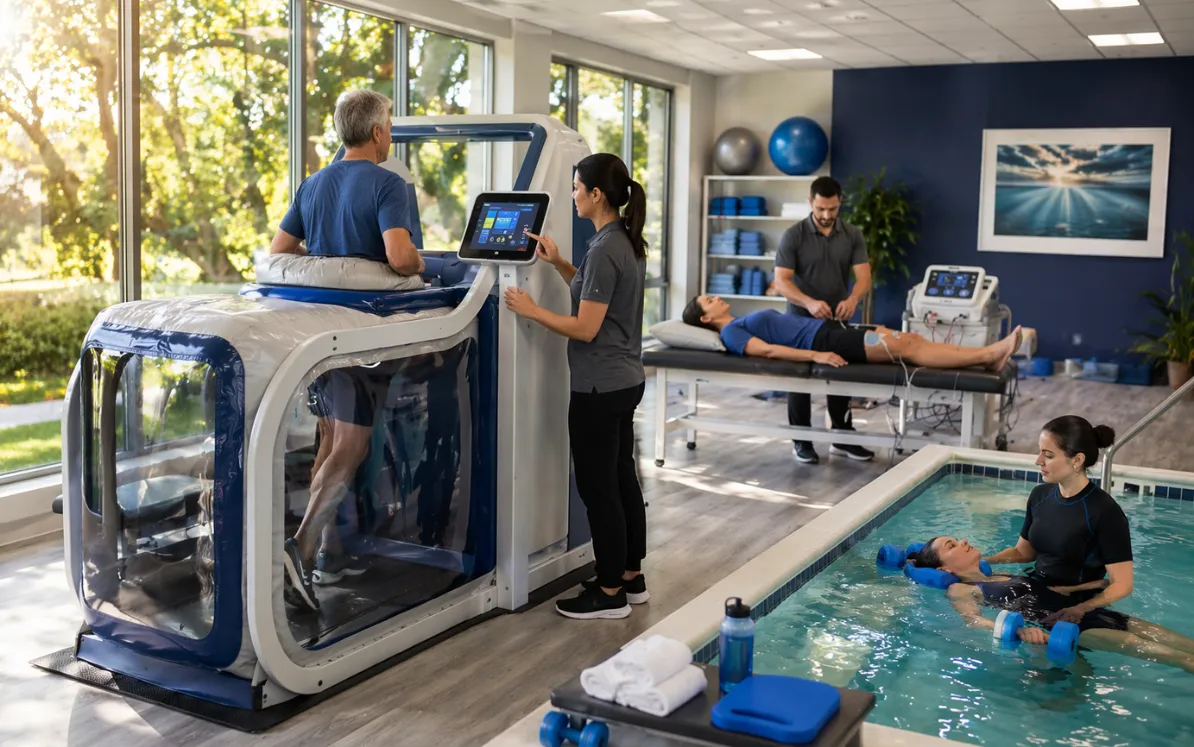
Advanced Physical Therapy Treatments: AlterG Treadmill, Electrotherapy and Aquatic Therapy
Physical therapy has undergone a significant technological evolution over the past two decades. Where rehabilitation once relied primarily on exercise, manual therapy, and basic electrical stimulation, today's leading physical therapy clinics offer a range of advanced treatment technologies that fundamentally change what rehabilitation can achieve — and for whom. Patients who would previously have faced months of limited progress or been told that certain recovery goals were unrealistic are now achieving outcomes that would have seemed ambitious just years ago.
Three technologies sit at the forefront of this evolution: the AlterG anti-gravity treadmill, electrotherapy in its modern clinical forms, and aquatic therapy delivered in a dedicated therapeutic environment. At iMotion Physical Therapy, all three are available and integrated within comprehensive rehabilitation programs that combine technological capability with the clinical judgment to use each modality at the right stage, for the right patient, in the right combination with the other tools in the clinic's treatment arsenal.
The AlterG Treadmill: Rehabilitation Without Gravity's Limitations
The AlterG anti-gravity treadmill represents one of the most genuinely transformative technologies to enter clinical physical therapy practice in recent years. Originally developed using NASA differential air pressure technology, the AlterG treadmill allows patients to walk or run at body weight percentages as low as 20 percent of their actual weight — reducing gravitational loading on the lower extremity, spine, and healing structures while preserving the natural movement pattern of walking or running that is essential for gait rehabilitation.
The clinical implications of this capability are profound. Consider a patient recovering from total knee replacement surgery: under standard rehabilitation protocols, full weight-bearing walking may not be appropriate for several weeks post-operatively, limiting both the gait training and the cardiovascular work that early recovery demands. With the AlterG treadmill, this patient can begin progressive walking rehabilitation within days of surgery at 40 or 50 percent body weight, receiving the neuromuscular input of normal gait mechanics while protecting the healing joint structures from the loads they are not yet ready to manage. This earlier initiation of gait training consistently translates into faster achievement of functional independence milestones.
The alt-g treadmill also serves patients whose conditions make land-based exercise of any intensity difficult to tolerate: individuals with severe osteoarthritis, patients managing chronic lower extremity conditions, runners recovering from stress fractures who need to maintain cardiovascular fitness while bone healing progresses, and neurological patients with gait deficits who benefit from the repetitive, supported movement practice that gait retraining requires. For all of these populations, the AlterG treadmill creates a rehabilitation pathway that would otherwise not exist.
Athletes, particularly runners and competitive sportspeople, represent another primary beneficiary of AlterG treadmill technology. The ability to maintain running-specific training at reduced loading during injury recovery preserves the cardiovascular fitness, the running mechanics, and the sport-specific neural patterns that would otherwise deteriorate during weeks of enforced rest — dramatically reducing the deconditioning that makes return-to-sport so challenging in traditional rehabilitation models.
Electrotherapy: Precision Stimulation for Multiple Clinical Purposes
Electrotherapy encompasses a range of modalities that use electrical current, electromagnetic fields, or ultrasonic energy to produce specific therapeutic effects in tissue — effects that complement manual therapy and exercise in ways that neither can achieve independently.
TENS (Transcutaneous Electrical Nerve Stimulation) delivers low-level electrical current through skin-surface electrodes to modulate pain signals at the spinal cord level, providing non-pharmacological pain management for both acute and chronic pain presentations. The mechanism — stimulation of large-diameter sensory nerve fibers that inhibit pain transmission through smaller nociceptive fibers — is well-understood and clinically effective for a broad range of pain conditions. TENS is particularly valuable in the early phases of post-surgical rehabilitation, when pain levels would otherwise limit the patient's engagement with the therapeutic exercise that drives recovery.
Neuromuscular electrical stimulation (NMES), also known as E-stim, uses a different current protocol to directly stimulate motor nerve fibers, producing muscle contractions in muscles that are inhibited by pain, swelling, or disuse. This is particularly relevant for quadriceps rehabilitation following knee surgery, where the characteristic quadriceps inhibition that develops after any knee injury or procedure significantly slows the strength recovery that functional rehabilitation depends on. NMES supplements voluntary exercise with externally driven muscle activation, accelerating the restoration of neuromuscular control.
Ultrasound therapy uses high-frequency acoustic energy — beyond the range of human hearing — to produce both thermal and non-thermal effects in deep tissue. Thermal effects include increased collagen extensibility and enhanced tissue healing rates in the target structures. Non-thermal effects include cavitation — the oscillation of gas bubbles in tissue fluid — which influences cell membrane permeability and can accelerate tissue repair processes. Clinical ultrasound is particularly effective for soft tissue injuries, tendon conditions, and scar tissue management in post-surgical rehabilitation.
Together, these electrotherapy modalities provide the iMotion clinical team with precise, targeted tools for pain management, tissue healing acceleration, and neuromuscular rehabilitation that complement the manual and exercise-based core of every rehabilitation program.
Motion Plus Aquatic and Therapy Center: Rehabilitation in Water
The iMotion San Jose clinic at 730 Empey Way functions as a motion plus aquatic and therapy center — offering both land-based physical therapy and a dedicated aquatic therapy program that extends the clinic's rehabilitation capabilities to patient populations who benefit specifically from the therapeutic properties of water.
Aquatic therapy exploits three fundamental properties of water to create a rehabilitation environment unlike anything available on land. Buoyancy reduces the effective weight the patient's musculoskeletal system must support, with the degree of weight reduction determined by the depth of immersion. A patient immersed to shoulder depth is supporting only approximately 10 percent of their body weight — creating conditions in which movement is possible with minimal joint loading. Hydrodynamic resistance — the resistance water provides to movement through it — increases proportionally with movement speed, creating a progressive strengthening stimulus that the patient can self-regulate by controlling their movement pace. Hydrostatic pressure — the even compression the surrounding water exerts on the body — reduces tissue swelling and provides proprioceptive input that supports balance and movement quality.
These properties combine to make aquatic therapy at the iMotion motion plus aquatic and therapy center in San Jose particularly valuable for post-surgical patients who need gentle early movement, patients with severe osteoarthritis for whom land-based exercise is too painful, neurological patients who benefit from the reduced fall risk and movement support that water provides, and patients managing obesity-related joint conditions that make conventional exercise difficult to sustain.
The San Jose aquatic facility, combined with iMotion's comprehensive land-based rehabilitation capabilities, provides a complete rehabilitation environment that addresses the needs of the widest possible range of patients across the continuum of rehabilitation complexity.
Conclusion
The AlterG treadmill, electrotherapy, and aquatic therapy are not individual products to be selected from a menu. They are components of an integrated treatment approach, and their value is fully realized only when skilled clinicians apply the judgment to determine which combination of tools serves each patient best at each stage of their recovery.
At iMotion Physical Therapy, this integration is the foundation of the clinical culture — technology in the service of outcomes, selected and combined by experienced therapists whose expertise turns equipment capability into patient results.


