
 Menu
Menu

What is LSVT BIG and LOUD? Benefits for Parkinson's Patients Explained
Parkinson's disease is a progressive neurological condition that affects movement and communication in ways that are both characteristic and, without the right intervention, progressively limiting. The shuffling gait, the reduced arm swing, the stooped posture and the quiet monotone voice that many people associate with Parkinson's disease are not inevitable consequences of the diagnosis. They are, to a significant degree, the result of a neurological process that responds to specific, targeted rehabilitation — and two of the most rigorously researched and clinically validated approaches available are the LSVT BIG and LSVT LOUD programs.
At iMotion Physical Therapy Fremont, LSVT BIG is delivered by certified physical therapists at the dedicated Mowry Avenue Neuro and Parkinson's rehabilitation clinic. Understanding what these programs are, how they work, and what they deliver for patients managing Parkinson's disease is essential knowledge for anyone navigating the rehabilitation options available to them.
The Science Behind LSVT: Amplitude Recalibration
LSVT stands for Lee Silverman Voice Treatment, named after a patient whose treatment outcomes contributed to the development of the original vocal therapy protocol. The LSVT approach was initially developed for the speech and voice changes associated with Parkinson's disease and subsequently extended to physical movement in the form of the LSVT BIG program. Both programs share the same neurological insight and the same therapeutic principle.
Parkinson's disease produces a neurological bias toward reduced amplitude across all movement outputs. This is not simply weakness or stiffness — it is a recalibration of the brain's sense of what constitutes a normal-sized movement. As dopamine production declines, the motor system loses the regulatory signal that maintains appropriate movement amplitude. The brain begins to accept smaller and smaller movements as normal, progressively compressing the range of physical action and vocal output that the patient uses.
The critical aspect of this process is that the reduction in amplitude is accompanied by a corresponding reduction in perceived effort. Patients with Parkinson's disease often feel that they are speaking at normal volume or moving with normal-sized steps when they are, objectively, doing neither. The internal reference point for normal has shifted downward alongside the actual output. This is why simply telling a Parkinson's patient to speak louder or take bigger steps produces only temporary improvement — the feedback loop that maintains amplitude has been disrupted at a neurological level.
LSVT addresses this directly. Both programs train patients to consistently and deliberately produce movements or vocal outputs that are objectively large in amplitude—not just slightly larger than habitual, but deliberately, intentionally big. The high-repetition, high-effort training over the course of the LSVT protocol recalibrates the patient's internal reference for normal amplitude, building a new neurological baseline that is both larger and more sustainable than the pre-treatment habitual amplitude.
LSVT BIG: Physical Therapy for Parkinson's Movement
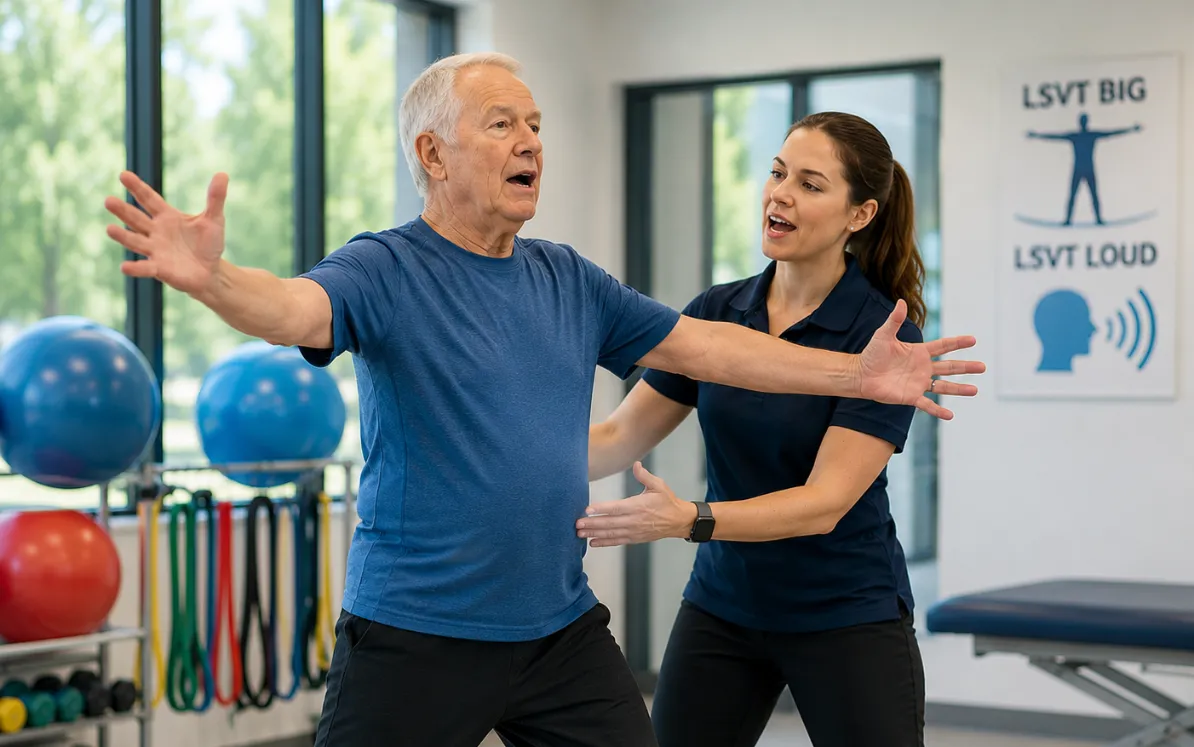
LSVT BIG is a physical therapy protocol specifically developed and validated for Parkinson's disease, delivering the amplitude recalibration principle across the full range of whole-body movement. The protocol is delivered by certified physical therapists in an intensive format: four individual sessions per week for four consecutive weeks, each session lasting approximately one hour.
The exercises within LSVT BIG focus on large-amplitude whole-body movements across the categories of motion most affected by Parkinson's disease—trunk rotation, weight shifting, reaching, stepping, and transitional movements between sitting and standing, standing and walking, and walking and turning. These movements are practiced with deliberate, exaggerated amplitude, and patients are coached to produce movements that feel larger than natural rather than movements that feel normal.
The research supporting LSVT BIG is substantial. Studies comparing LSVT BIG to conventional physical therapy and to home exercise programs have consistently demonstrated greater improvements in walking speed, stride length, balance performance, and overall functional movement quality in the LSVT BIG group. Crucially, these improvements have been shown to be durable at follow-up assessments—the amplitude recalibration produced by the intensive protocol persists and continues to influence habitual movement patterns after the formal treatment period concludes.
At physical therapy Fremont at iMotion, the LSVT BIG program begins with a comprehensive movement assessment that establishes baseline measurements across gait, balance, functional movement quality, and the specific activities of daily living most important to each patient. Treatment is individualized within the protocol framework, and the home exercise component — daily practice of the LSVT BIG movements between clinic sessions — is an essential element of the program's effectiveness.
LSVT LOUD: Speech Therapy for Parkinson's Voice
LSVT LOUD is the companion speech therapy protocol, addressing the vocal and communication changes that Parkinson's disease produces with the same amplitude recalibration approach. The voice changes associated with Parkinson's disease—reduced volume (hypophonia), monotone pitch, imprecise articulation, and a speech quality that makes communication increasingly effortful for both speaker and listener—significantly affect quality of life and social engagement.
LSVT LOUD is delivered by certified speech language pathologists in the same intensive format as LSVT BIG: four sessions per week for four weeks. The core exercise is deceptively simple and powerfully effective: patients practice producing a sustained, maximum-effort vowel sound at loud volume, consistently and repeatedly, building the neural pathway for loud vocal output that Parkinson's disease has progressively suppressed.
Like LSVT BIG, LSVT LOUD produces improvements that extend beyond the specific exercise practiced in treatment sessions. Patients who complete LSVT LOUD demonstrate improvements in spontaneous conversational volume, speech intelligibility, and the communicative confidence that comes from being able to speak and be heard without effort. The carryover from the intensive treatment into daily communication reflects the amplitude recalibration that the protocol is designed to achieve.
At iMotion Physical Therapy Fremont, speech therapy services including LSVT LOUD are available through the clinic's multidisciplinary rehabilitation team, providing patients with access to both the physical and vocal dimensions of Parkinson's rehabilitation within the same clinical environment.
Conclusion
LSVT BIG and LSVT LOUD are not general exercise and speech programs that any therapist can deliver under the LSVT name. They are specific, manualized protocols with defined exercises, defined progression criteria, and defined session structure. Provider certification through the LSVT Global organization ensures that the therapist delivering the program has the training to implement the protocol with the fidelity that the research evidence was built upon.
For patients and families evaluating rehabilitation options for Parkinson's disease, asking specifically whether a physical therapist or speech therapist is LSVT certified is a meaningful and appropriate quality indicator. The outcomes demonstrated in LSVT research are outcomes produced by certified providers following the protocol — not outcomes that can be assumed from similar-sounding therapy.
At iMotion Physical Therapy Fremont, LSVT BIG and LSVT LOUD-certified providers deliver these evidence-based programs as part of a comprehensive Parkinson's rehabilitation offering that addresses the full spectrum of movement and communication challenges that the condition presents.


