
 Menu
Menu

How Therapists Help Manage Parkinson's Disease Symptoms Effectively
How Therapists Help Manage Parkinson's Disease Symptoms Effectively
Parkinson's disease is one of the most complex neurological conditions a person can face. It is progressive, unpredictable, and deeply personal—affecting not just movement but confidence, independence, and quality of life. While there is currently no cure, the way a person manages Parkinson's can make an enormous difference in how slowly it progresses, how well they function day to day, and how much control they retain over their own body.
Physical therapy is one of the most powerful tools available to people living with Parkinson's disease—and it is still significantly underutilized. Research consistently shows that targeted, specialized therapy can slow the progression of motor symptoms, improve balance and coordination, reduce fall risk, and even help preserve cognitive function. The key word is "specialized." Not all therapy is created equal when it comes to Parkinson's, and working with therapists who understand the nuances of the condition is critical.
This guide explores how therapists help manage Parkinson's disease symptoms effectively—and why starting therapy early can change the entire trajectory of the condition.
Understanding Parkinson's Disease: What's Actually Happening
Parkinson's disease occurs when dopamine-producing neurons in a region of the brain called the substantia nigra begin to degrade and die. Dopamine is the neurotransmitter responsible for smooth, coordinated muscle movement. As dopamine levels decline, the brain loses its ability to send clear, fluid movement signals—resulting in the characteristic symptoms of the disease.
Motor symptoms include resting tremor (often the most recognizable sign), rigidity or stiffness in the muscles and joints, bradykinesia (slowness of movement), and postural instability that increases fall risk. Non-motor symptoms—often underappreciated—include cognitive changes, depression and anxiety, sleep disturbances, fatigue, and swallowing difficulties.
Parkinson's affects every person differently. Two individuals with the same diagnosis may experience vastly different symptom profiles, rates of progression, and responses to treatment. This variability is precisely why personalized, therapist-guided care is so important.
The Role of Physical Therapy in Parkinson's Disease
Physical therapy for Parkinson's is not about general fitness—it is neurological rehabilitation. It targets the specific motor and functional deficits that Parkinson's creates and works to preserve or restore them through evidence-based techniques.
Gait Training and Walking Rehabilitation
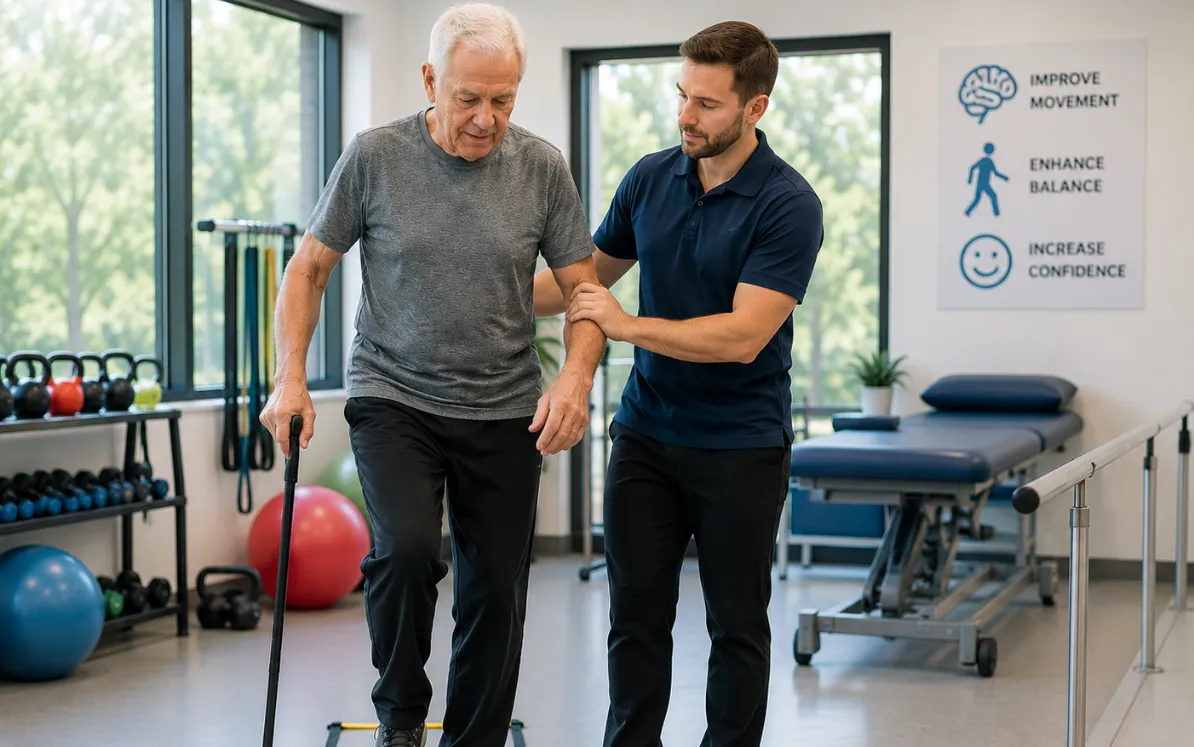
One of the most common and dangerous symptoms of Parkinson's is festination—a pattern of short, shuffling steps that gradually accelerate, often leading to freezing or falls. Physical therapists use rhythmic auditory cueing (such as metronome beats), visual floor cues, and structured gait training protocols to help patients take larger, more deliberate steps and maintain a safer walking pattern.
The LSVT BIG program — one of the most evidence-backed physical therapy protocols specifically developed for Parkinson's — trains patients to make all movements bigger and more exaggerated. Because Parkinson's causes people to perceive normal-sized movements as too large, this recalibration of movement amplitude produces dramatic improvements in walking speed, stride length, and overall motor function.
Balance and Fall Prevention
Falls are one of the leading causes of injury and hospitalization in people with Parkinson's. As the disease disrupts the automatic postural reflexes that keep us upright, therapists work to strengthen the muscles that support balance and retrain the nervous system's reactive responses. Exercises targeting the core, hips, and ankles — combined with dynamic balance challenges — progressively build the stability that Parkinson's erodes.
Rigidity and Flexibility Management
Muscle stiffness and joint rigidity not only cause pain and discomfort but also restrict range of motion and contribute to the stooped posture commonly associated with Parkinson's disease Physical therapists use manual therapy, targeted stretching protocols, and mobility exercises to combat rigidity, improve joint movement, and counteract the forward flexion posture that develops over time.
Strength and Endurance Training
Progressive resistance training has shown promising results in people with Parkinson's, helping to counteract the muscle weakness and fatigue that accompany the disease. A well-designed strengthening program — tailored to the individual's current level and progressed carefully — supports overall function and helps maintain independence for longer.
Occupational Therapy: Managing Daily Life with Parkinson's
While physical therapy focuses primarily on movement and motor function, occupational therapy (OT) addresses the practical challenges of daily living that Parkinson's creates. Fine motor tasks—handwriting, buttoning a shirt, using utensils—become increasingly difficult as tremor and rigidity progress. Occupational therapists help patients develop compensatory strategies, adaptive equipment use, and home modifications that maintain independence and safety.
For those experiencing cognitive changes, OT can also help establish routines, memory aids, and organizational systems that reduce daily stress and maintain cognitive engagement.
Speech and Swallowing Therapy: An Often-Overlooked Essential
Many people with Parkinson's develop hypophonia — a softening and weakening of the voice — as well as dysarthria (slurred speech) and dysphagia (difficulty swallowing). These symptoms profoundly affect communication and nutritional intake, yet they are frequently underaddressed.
Speech-language pathologists use the LSVT LOUD protocol — the vocal equivalent of LSVT BIG — to help patients speak louder, more clearly, and with greater expression. Swallowing therapy addresses the muscular coordination required for safe eating and drinking, reducing the risk of aspiration pneumonia, which is a significant cause of mortality in Parkinson's.
Exercise as Medicine: The Science Behind Movement
Beyond formal therapy, regular physical exercise has been shown to have neuroprotective effects in Parkinson's disease. Aerobic exercise — particularly high-intensity activity — stimulates neuroplasticity, the brain's ability to form new connections and adapt around damaged areas. Activities such as cycling, dancing, boxing, and swimming have all demonstrated measurable benefits in clinical studies.
Therapists play a crucial role in helping patients identify exercises that are safe, enjoyable, and neurologically beneficial—and in teaching them how to exercise independently between therapy sessions. Consistency is everything. A patient who exercises three to five days per week outside of clinic visits will see significantly better outcomes than one who relies on therapy sessions alone.
Starting Early Makes the Greatest Difference
The most important thing to understand about physical therapy for Parkinson's is this: earlier is always better. The nervous system's capacity for plasticity is greatest when the disease is in its earliest stages. Establishing strong movement habits, balance strategies, and physical fitness before symptoms become severe creates a neurological foundation that slows the rate of functional decline.
Many people wait until they are struggling significantly before seeking therapy. By that point, they have often already developed compensatory movement patterns, experienced falls, and lost confidence in their physical abilities. Therapy at that stage is still valuable—but the outcomes are better and the road shorter when intervention begins early.
Frequently Asked Questions
Q: Can physical therapy actually slow the progression of Parkinson's disease?
While physical therapy cannot stop the underlying neurological progression of Parkinson's, strong evidence shows that regular, targeted exercise and therapy can significantly slow the rate of functional decline. Studies have demonstrated that exercise promotes neuroplasticity—the brain's ability to adapt and reorganize—which helps compensate for the dopamine loss that drives the disease. Patients who engage in consistent physical therapy and exercise programs maintain better motor function, balance, and independence for longer than those who do not.
Q: How often should someone with Parkinson's see a physical therapist?
This depends on the stage and severity of symptoms. In the early stages, an evaluation and periodic check-ins (every 3–6 months) may be sufficient, combined with a robust home exercise program. As symptoms progress, more frequent visits — typically 2–3 times per week — become beneficial. The goal of therapy is always to maximize independent function between sessions, so home exercise adherence is equally important as clinic attendance.
Q: What is LSVT BIG and who is it for?
LSVT BIG (Lee Silverman Voice Treatment BIG) is a standardized physical and occupational therapy protocol specifically developed and validated for Parkinson's disease. It is delivered over four weeks, with four sessions per week, and focuses on training patients to make all movements larger in amplitude. It has strong research support for improving walking speed, balance, and quality of life. It is suitable for people at various stages of Parkinson's and is delivered by therapists with specific LSVT certification.
Q: Is it safe to exercise vigorously with Parkinson's disease?
Yes — with proper guidance. High-intensity aerobic exercise has been shown to be not only safe but particularly beneficial for people with Parkinson's, as it most effectively stimulates the neuroprotective mechanisms in the brain. However, intensity and type of exercise should always be prescribed and progressed by a qualified physical therapist who understands the individual's cardiovascular health, medication schedule, and symptom profile. Safety — particularly regarding fall risk — must always be carefully considered.
Q: Can therapy help with tremors?
Therapy cannot eliminate resting tremors caused by Parkinson's, as these originate from the neurological changes of the disease itself and are primarily managed through medication. However, therapists can help patients develop strategies to manage the functional impact of tremors—such as using weighted utensils, adaptive equipment, and positioning techniques—and can address associated rigidity, which often worsens the experience of tremors.
Q: When should someone with Parkinson's first see a physical therapist?
Ideally, at or shortly after diagnosis—even if symptoms are mild. Early intervention establishes a baseline, educates the patient about what to expect, begins building the exercise habits that will be protective long-term, and ensures the patient has professional support before significant functional challenges arise. A proactive approach to Parkinson's management is always more effective than a reactive one.
Q: Does insurance cover physical therapy for Parkinson's disease?
In most cases, yes. Physical therapy for Parkinson's disease is recognized as medically necessary and is covered by Medicare, Medicaid, and most private insurance plans. Coverage details — including the number of visits covered per year and cost-sharing requirements — vary by plan. In California, patients can access physical therapy directly without a physician's referral for up to 12 visits or 45 days, making it easier to begin care promptly.
Conclusion
Managing Parkinson's disease is not a sprint—it is a lifelong commitment to active, engaged self-care supported by a skilled clinical team. Physical therapists, occupational therapists, and speech-language pathologists are not peripheral to that care. They are central to it.
The most empowered patients with Parkinson's are those who treat therapy not as something they do when things get bad, but as a consistent, ongoing investment in their function, safety, and independence. With the right team, the right program, and the right mindset, living well with Parkinson's is not just a possibility—it is an achievable daily reality.


