
 Menu
Menu

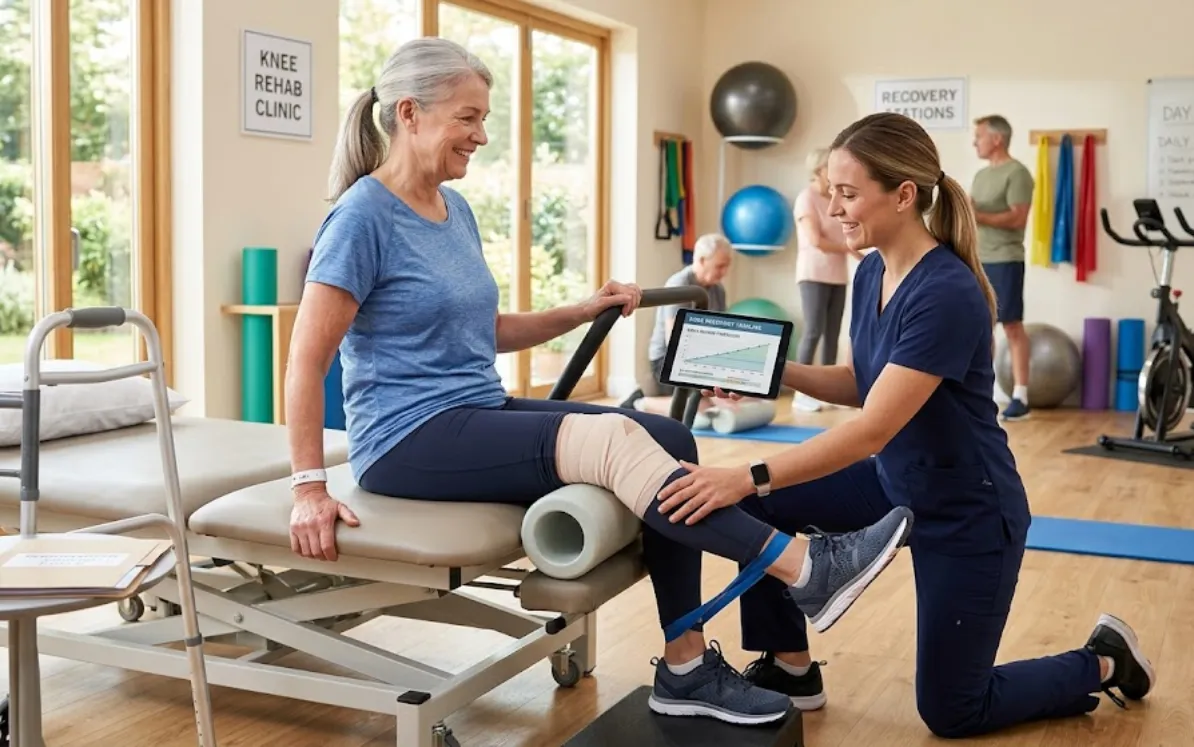
What Is the Fastest Way to Recover After Knee Replacement Surgery?
The Recovery Question Every Knee Replacement Patient Asks
You have been through the surgery. The procedure went well. Now you are lying in a hospital bed with a swollen knee, a walker nearby, and one question running through your mind: how long is the recovery actually going to take?
It is one of the most common questions orthopedic patients ask and the honest answer is that recovery speed is not random. It is largely determined by decisions made in the first days and weeks after surgery.
Rehab therapy for knee replacement, started early and delivered by a skilled physical therapist, is the single most influential factor in how fast you recover. Not the implant brand. Not the surgical approach. Not your age alone.
What happens in rehabilitation and when it starts determines whether you are walking independently at six weeks or still struggling at three months.
What Is the Fastest Way to Recover After Knee Replacement?
The fastest recovery after knee replacement surgery involves five evidence-based steps: starting physical therapy within 24 hours of surgery, attending consistent outpatient PT sessions 2–3 times per week, following a daily home exercise program, managing swelling with ice and elevation, and working with a specialized knee replacement rehab therapy team. Patients who start PT early and stay consistent typically walk without assistance within 3–6 weeks and return to full daily activities within 3 months.
Why Early Movement Is the Most Important Thing You Can Do
Most people assume recovery means rest. It does not, at least not complete rest.
Research consistently shows that patients who begin moving the new joint within 24 hours of surgery recover faster, regain range of motion more completely, and experience fewer complications than those who wait.
Here is why. After knee replacement surgery, your body immediately begins laying down scar tissue around the joint. This is part of the healing process, but scar tissue has no flexibility. The longer the joint stays still, the more scar tissue organizes itself into restrictive patterns that limit bending and straightening for months.
Early movement, even gentle, supported movement under therapist guidance guides scar tissue to form in organized, flexible patterns. This is not a small detail. For many patients, the difference between a knee that bends to 120 degrees and one that tops out at 90 degrees comes down to what happened in the first two weeks of rehab.
At iMotion Physical Therapy's Lake Clinic on Paseo Padre Parkway in Fremont, knee replacement patients begin their rehabilitation program as soon as they are medically cleared, often within the first week of discharge. The team does not wait for swelling to fully resolve before beginning movement. They work with it.
The Phases of Knee Replacement Rehab Therapy
Recovery does not happen in one continuous upward line. It moves through distinct phases, each with specific goals.
Phase 1: Hospital and Immediate Home Recovery (Days 1–14)
This phase is about safety and basic function. You will stand, transfer, and take your first steps, usually with a walker. A physical therapist begins range-of-motion work and basic quad activation exercises.
The goals here are straightforward: get the knee bending to at least 90 degrees, reduce acute swelling, and establish a safe home environment.
Practical tip: Do not skip your home exercises during this phase. The 10-minute routine your therapist sends you home with is not optional; it is what bridges the gap between clinic sessions and keeps the joint moving between appointments.
Phase 2: Early Outpatient PT (Weeks 2–6)
This is where most of the meaningful recovery work happens. You will attend orthopedic rehab in Fremont 2 to 3 times per week. Sessions focus on:
Increasing range of motion progressively
Rebuilding quadriceps and hamstring strength
Gait retraining learning to walk normally without compensation patterns
Stair negotiation and functional movement
Manual therapy to address scar tissue and joint stiffness
Most patients transition from a walker to a cane during this phase. By week six, many are walking short distances unassisted.
Phase 3: Strengthening and Return to Function (Weeks 6–12)
Swelling has largely resolved. Range of motion is near its final range. The focus shifts to building the strength, balance, and endurance needed for real-life activities like grocery shopping, driving and climbing stairs without holding the railing.
At iMotion Physical Therapy Fremont, this phase often incorporates AlterG anti-gravity treadmill work, allowing patients to walk at a reduced percentage of body weight. This lets the joint work through full gait mechanics before it is ready to handle the complete load closing the gap between "walking in the clinic" and "walking in real life."
Phase 4: Full Return to Activity (Months 3–12)
Low-impact activities cycling, swimming, golf and walking for fitness, typically return during this phase. The timeline varies significantly based on age, baseline fitness, and how the earlier phases went.
For patients who start early and attend consistently, months 3 to 6 often bring a noticeable shift: the new knee stops feeling like a foreign object and starts feeling like part of the body again.
Five Things That Directly Speed Up Recovery
1. Start Outpatient PT in the Right Window
The ideal window to begin outpatient Fremont physical therapy after knee replacement is weeks 2 to 3 post-surgery. Starting later than week 4 allows scar tissue to consolidate, making range-of-motion work significantly harder and more uncomfortable.
2. Manage Swelling Actively
Swelling is the enemy of knee mobility. A swollen joint cannot move freely; the fluid pressure physically restricts range of motion. Ice 15 to 20 minutes after every exercise session. Elevate the leg above heart level when resting. Do not interpret swelling as a reason to stop moving; interpret it as a reason to manage it consistently.
3. Do Your Home Exercises Without Exception
Clinical sessions are 2 to 3 times per week. The other 4 to 5 days are the home program. Patients who treat their home exercises as non-negotiable not optional and not something to do when they feel like it recover measurably faster than those who only work on the knee during formal sessions.
4. Prioritize Sleep and Nutrition
Tissue heals during sleep. Protein supports collagen formation and muscle rebuilding. These are not secondary factors they are part of the recovery infrastructure. Aim for adequate protein intake (your surgeon or therapist can provide specific guidance) and protect sleep quality even when the knee is uncomfortable.
5. Work With a Team That Specializes in Joint Rehabilitation
General physical therapy clinics see a wide range of conditions. iMotion Physical Therapy's Lake Clinic on Paseo Padre Parkway in Fremont specializes in orthopedic and post-surgical rehabilitation with therapists who have managed hundreds of knee replacement recoveries and know what normal progression looks like at every stage.
That clinical experience matters. It means your therapist recognizes when recovery is on track, when something needs to be adjusted, and when a complication needs to be flagged back to your surgeon.
What Slows Recovery Down
Understanding what derails recovery is as useful as knowing what accelerates it.
Missing sessions mid-recovery is the most common and most damaging mistake. Missing two weeks of PT at weeks 4 to 6 can set range-of-motion progress back significantly and that ground is hard to recover.
Overdoing activity too early, believing that more movement always means faster recovery, is the opposite error. Doing too much before the joint is ready creates reactive swelling that limits mobility and forces a step backward.
Untreated pain that prevents participation is a legitimate barrier. Pain during early recovery is expected. Pain that prevents you from attending or engaging in therapy needs to be communicated to both your therapist and your surgeon so it can be managed.
Is iMotion Physical Therapy Right for Your Recovery?
iMotion Physical Therapy's Lake Clinic on Paseo Padre Parkway in Fremont serves knee replacement patients from across the Fremont, Newark, Union City, and Hayward areas. The clinic offers:
One-on-one, hands-on knee replacement rehab therapy
AlterG anti-gravity treadmill for progressive gait training
Manual therapy for scar tissue and joint mobility
Aquatic therapy options at select locations
Experienced orthopedic rehab team familiar with all major prosthetic systems
iMotion also provides physical therapy for back pain rehabilitation, sports injuries, Parkinson's therapy, and broader orthopedic conditions, making it a comprehensive rehabilitation resource for the East Bay community.
Frequently Asked Questions
Q: How soon after knee replacement surgery should I start physical therapy?
A: Physical therapy begins in the hospital within 24 hours of surgery. In most cases a therapist helps you stand and take your first steps before discharge. Outpatient knee replacement rehab therapy at a clinic like iMotion typically starts at weeks 2 to 3, once you are stable enough to travel and ready for structured rehabilitation. Starting later than week 4 increases the risk of stiffness that is harder to reverse.
Q: Is iMotion Physical Therapy considered one of the best inpatient physical rehab facilities near me?
A: iMotion Physical Therapy operates as an outpatient rehabilitation clinic meaning patients attend scheduled sessions rather than residing at the facility. For Fremont residents and East Bay patients recovering from knee replacement, iMotion's Lake Clinic on Paseo Padre Parkway provides the hands-on, specialized orthopedic rehab Fremont, CA care that produces outcomes comparable to more intensive inpatient settings, with the flexibility of outpatient scheduling.
Q: How many PT sessions will I need after knee replacement?
A: Most patients attend 2 to 3 sessions per week for the first 6 to 8 weeks, then reduce to 1 to 2 weekly sessions as the home program takes over more of the work. Total session count typically ranges from 20 to 30 visits over a 3-month period, though this varies by individual progress. Your therapist at iMotion will outline a projected timeline at your initial evaluation.
Q: What is the AlterG treadmill and how does it help knee replacement recovery?
A: The AlterG anti-gravity treadmill uses air pressure to reduce the effective body weight a patient carries while walking as low as 20% of full body weight, adjustable in 1% increments. For knee replacement patients, this allows full gait training before the joint is ready to handle complete load. It bridges the gap between early protected walking and full weight-bearing activity and is available at iMotion Physical Therapy Fremont.
Q: Can I recover from knee replacement without going to physical therapy?
A: Technically possible but the outcomes are significantly worse. Research consistently shows that structured knee replacement rehab therapy with a licensed physical therapist produces better range of motion, faster return to function, lower complication rates, and higher patient satisfaction than home exercise alone. The joint replacement is the beginning of recovery, not the end. PT is what completes it.
Conclusion
Knee replacement surgery gives you a new joint. Knee replacement rehab therapy teaches you how to use it and how to use it well for the long term.
The patients who recover fastest are not always the youngest or the fittest going in. They are the ones who start early, show up consistently, do their home exercises without exception, and work with a team that knows what good recovery looks like at every stage.
At iMotion Physical Therapy's Lake Clinic in Fremont, that team is ready.


