
 Menu
Menu

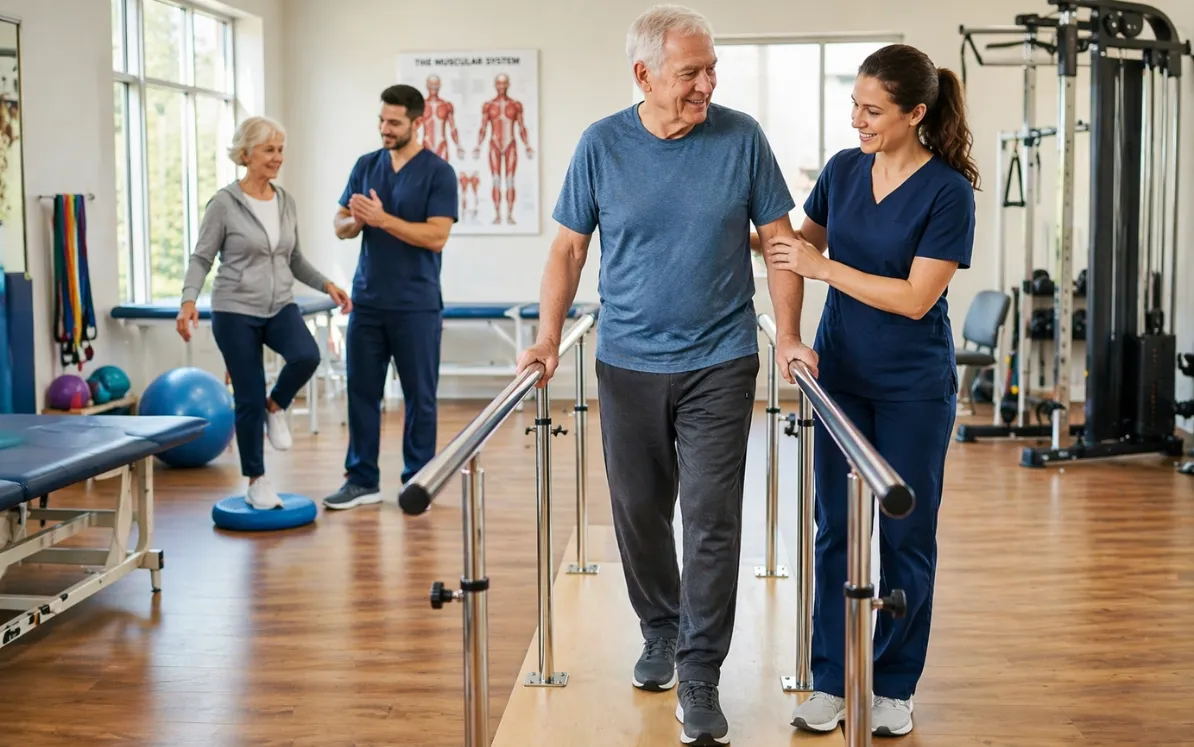
How Physical Therapy Helps Parkinson's Patients Improve Mobility
Parkinson's disease is a progressive neurological condition that affects movement in ways that go far beyond tremor. For the millions of Americans living with Parkinson's, the daily experience of the disease involves a gradual narrowing of the movement world: shorter steps, more difficulty turning, greater hesitation when initiating movement, a posture that pulls increasingly forward, and the constant awareness that the ground is less forgiving than it used to be.
Physical therapy cannot reverse Parkinson's disease. But it can do something profoundly meaningful: it can change the trajectory of how that condition affects functional mobility over time. Across the country, from specialized urban clinics in the Bay Area to community-based providers seeking to expand their neurological rehabilitation capabilities in areas like Murrieta, CA, the field of Parkinson's physical therapy is being reshaped by evidence-based approaches that produce measurably better outcomes than general exercise or standard rehabilitation protocols.
Understanding what those approaches involve and why specialized therapists for Parkinson's disease achieve outcomes that non-specialized care often cannot is essential knowledge for patients, families, and caregivers navigating the treatment landscape.
What Parkinson's Does to Movement
To understand why physical therapy for Parkinson's disease requires specialization, it is necessary to understand what the condition actually does to the movement system.
Parkinson's disease involves the progressive loss of dopamine-producing neurons in the substantia nigra, a region of the brain central to the initiation and smooth execution of voluntary movement. Dopamine acts as the chemical signal that allows the motor system to operate with the automaticity and amplitude that normal movement depends upon. As dopamine production declines, the movement system loses access to this automatic regulation, and a characteristic pattern of motor changes emerges.
Bradykinesia, the slowing and reduced amplitude of movement, is often the most functionally limiting feature. Patients move more slowly, with a smaller range, and the actions that were once automatic require deliberate conscious effort. Rigidity produces the muscular stiffness and resistance that many patients describe as a feeling of being locked. Postural instability impairs the automatic balance corrections that normally prevent falls following unexpected disturbances. Gait disturbance, including the festinating small shuffling steps and the freezing episodes that can stop a patient mid-stride, creates significant safety risks and limits independent mobility.
Together, these features produce a movement profile that is not simply weak or stiff, but neurologically specific in its pattern. This specificity is why parkinsons physical therapy in Murrieta CA and across the country produces the best outcomes when delivered by therapists with dedicated training in neurological rehabilitation and the Parkinson's-specific approaches that research has validated.
LSVT Big and Loud: The Evidence-Based Standard
Among the specialized approaches that have transformed outcomes for Parkinson's patients, LSVT Big and Loud stands as one of the most rigorously researched and widely validated in the field.
LSVT Big physical therapy protocol specifically designed for Parkinson's disease, developed by the same research team that created the LSVT Loud speech therapy approach for vocal loudness. The fundamental insight behind LSVT Big is that Parkinson's disease consistently produces a neurological bias toward reduced movement amplitude: smaller steps, less arm swing and more compact overall movement. The brain recalibrates its sense of "normal" movement downward as the condition progresses, accepting increasingly diminished amplitude as appropriate.
LSVT Big directly counters this recalibration by systematically training the patient to produce deliberate, exaggerated-amplitude movements across all categories of motor function: whole-body movements in sitting and standing, weight shifts, stepping, reaching, turning, and transitional movements between positions. The training is high-effort, high-repetition, and high-intensity by design. Research has consistently demonstrated that this approach produces meaningful improvements in stride length, walking speed, balance performance, and the quality of everyday functional movements for Parkinson's patients across the range of disease stages.
LSVT Loud, the companion speech therapy protocol, addresses the hypophonia, the reduced vocal volume, and the monotone speech quality that Parkinson's disease produces with the same high-amplitude training principle applied to voice. The programs are often delivered in parallel for patients experiencing both motor and speech symptoms.
For individuals seeking parkinsons physical therapy in Murrieta CA or anywhere in California, asking specifically about LSVT Big certification and Parkinson's-specific training experience is a meaningful quality indicator when evaluating potential therapy providers.
PWR! Moves: Building Parkinson's-Specific Functional Capacity
Alongside LSVT Big, the PWR! (Parkinson Wellness Recovery) framework provides physical therapists with a structured set of Parkinson's-specific movement exercises that can be individualized to the patient's current functional level and progressed systematically over time.
PWR! Moves are based on four foundational whole-body movement patterns that are specifically affected by Parkinson's disease: antigravity extension, weight shifting, axial rotation, and transitional movement between positions. These patterns are practiced in multiple body positions and across progressively challenging functional contexts, building the movement capacity that daily activities require.
At iMotion Physical Therapy, PWR! certified therapists for Parkinson's disease deliver this approach at the dedicated Mowry Avenue Neuro and Parkinson's Rehabilitation clinic in Fremont, California. The clinic provides a specialized neurological rehabilitation environment where patients with Parkinson's disease work with therapists whose training, clinical focus, and daily practice center on exactly the movement challenges that define the condition's impact on mobility.
The program at iMotion begins with a comprehensive movement evaluation: gait analysis, balance testing, assessment of postural stability, and a detailed conversation about the patient's symptoms, daily functional priorities, and goals for rehabilitation. Treatment is built around this individual profile and evolves as the patient's needs and capacities change over time.
What Specialized Therapists for Parkinson's Disease Bring
The difference between general physical therapy and care delivered by therapists with dedicated Parkinson's training manifests in multiple ways.
Clinical assessment by specialized therapists for Parkinson's disease includes detailed evaluation of the Parkinson's-specific movement features that general assessment tools may not capture: freezing of gait, dual-task performance, turning quality, and the functional transfer movements that carry the highest fall risk. Treatment decisions are grounded in an understanding of Parkinson's disease as a neurological condition that requires neurological principles in rehabilitation rather than musculoskeletal approaches applied to a neurological presentation.
Exercise prescription by Parkinson's-specialized therapists is calibrated for the specific demands of neurological rehabilitation: high amplitude, high repetition, cognitively engaging, and designed for carryover into the daily activities that matter most to the individual patient. Caregiver education is integrated throughout, because the movement principles that therapy establishes need to be reinforced consistently in the home environment to achieve durable outcomes.
Accessing Specialized Parkinson's Physical Therapy
For patients and families in California seeking the highest standard of Parkinson's physical therapy, whether in the Bay Area or researching options from areas including Murrieta, iMotion Physical Therapy's dedicated Parkinson's and neurological rehabilitation program represents the clinical standard that this condition demands.
Contact iMotion Physical Therapy to schedule a Parkinson's evaluation and discuss how the LSVT BIG, PWR! certified, and Parkinson's-specialized approach can be applied to your specific situation.
Fremont Mowry Clinic (Neuro and Parkinson's Rehab): (510) 745-7700 San Jose: (408) 275-1500 Los Gatos: (408) 358-3631 Visit imotionpt.com to learn more about the Parkinson's rehabilitation program and request an evaluation online.
Frequently Asked Questions
When should someone with Parkinson's disease start physical therapy?
As early as possible. Physical therapy helps at every stage of Parkinson’s, especially when started early to build a baseline, address issues sooner, and maintain better mobility over time.
What is LSVT Big and how is it different from regular exercise?
LSVT BIG is a Parkinson’s-specific therapy that trains patients to use larger, high-effort movements. It focuses on recalibrating movement perception through intensive, repetitive exercises delivered by certified therapists.
What is the PWR! program and who is it for?
PWR! (Parkinson Wellness Recovery) is a Parkinson’s-focused exercise program that targets key movement patterns. It can be adapted for all stages and individualized to each patient’s needs.
How often should a Parkinson's patient attend physical therapy?
Frequency varies by stage and goals. LSVT BIG is typically 4 sessions/week for 4 weeks, followed by maintenance. Ongoing therapy is often 1–2 times/week with home exercises.
Does physical therapy help with Parkinson's freezing of gait?
Yes. Freezing of gait is a common and challenging Parkinson’s symptom that increases fall risk. Specialized Parkinson’s physical therapy uses gait training with rhythmic sounds, visual cues, and focused attention strategies to help patients better manage and overcome freezing episodes.
Does iMotion offer Parkinson's physical therapy in Fremont and San Jose?
Yes. iMotion provides Parkinson's physical therapy at all locations except the Lake clinic. The Mowry Avenue clinic in Fremont is a dedicated Neuro and Parkinson's Rehabilitation center with PWR! certified providers. The San Jose and Los Gatos clinics also provide Parkinson's physical therapy. Contact Fremont at (510) 745-7700, San Jose at (408) 275-1500, or Los Gatos at (408) 358-3631 to schedule an evaluation.


