
 Menu
Menu

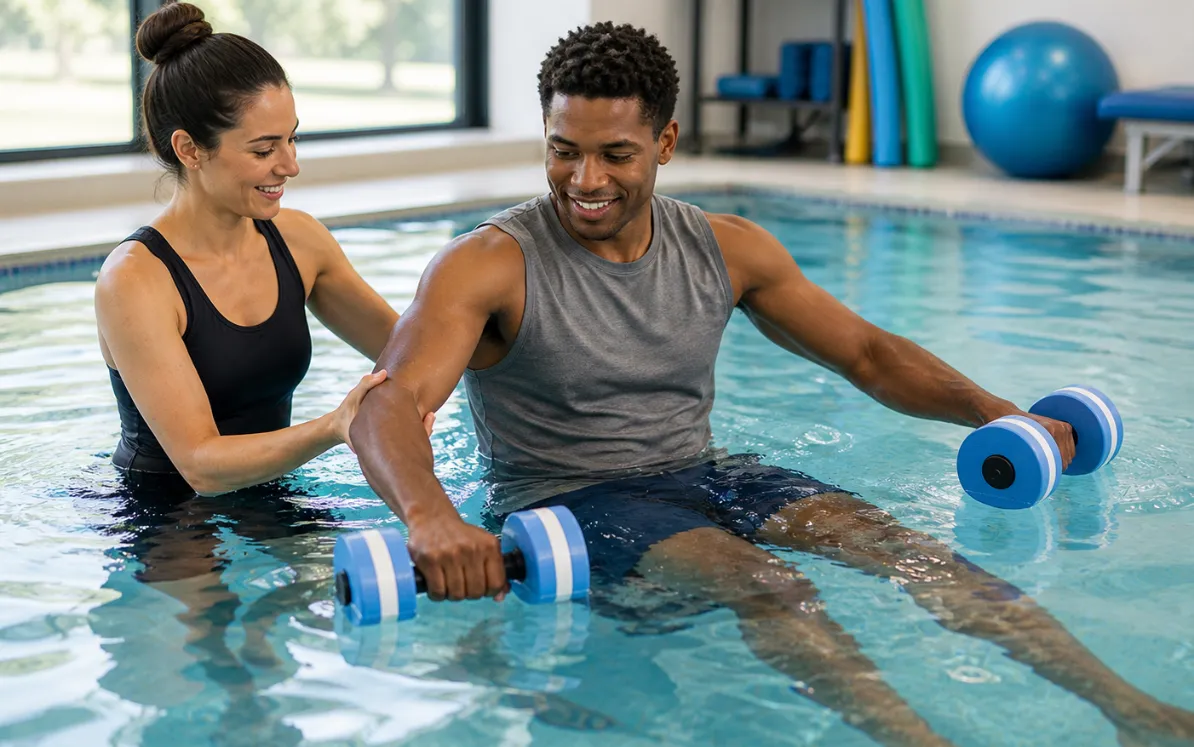
How Motion Plus Aquatic and Therapy Center Helps in Sports Injury Recovery
Sports injuries interrupt more than physical activity. They interrupt the training schedules, competitive seasons, personal goals, and daily routines that athletes and active individuals build their lives around. The urgency to return is real and legitimate, but returning too quickly — before true functional recovery has been achieved — reliably produces the same injury again, often more severely. The challenge is finding a rehabilitation pathway that moves as quickly as the biology of tissue healing allows while building the genuine functional readiness that durable return to sport requires.
For many sports injury presentations, that pathway runs through water before it runs through the gym. The motion plus aquatic and therapy center at iMotion Physical Therapy in San Jose offers a rehabilitation environment that changes what is possible in the early and intermediate stages of sports injury recovery — allowing therapeutic movement at loading levels that would otherwise be contraindicated on land, and producing functional gains that translate directly into faster return to athletic activity.
Why Aquatic Therapy Accelerates Sports Injury Recovery
The clinical advantage of aquatic therapy in sports injury recovery is rooted in the physical properties of water that no land-based environment can replicate.
Buoyancy reduces the mechanical load on injured structures proportionally to immersion depth. At shoulder depth, the athlete is supporting approximately 10 percent of their body weight. This reduction in gravitational loading does not eliminate the therapeutic stimulus — the resistance of water movement and the proprioceptive demands of maintaining position and control in the pool create meaningful exercise conditions — but it removes the compressive and shear forces that make land-based exercise contraindicated in the early stages of ligament, cartilage, and joint injuries.
For a soccer player recovering from a grade two ankle sprain, or a runner managing a stress fracture of the tibia, or a basketball player beginning rehabilitation after ACL reconstruction, the ability to begin full cardiovascular training, lower extremity strengthening, and movement quality work in the pool weeks before land-based loading would be appropriate dramatically compresses the overall recovery timeline. The cardiovascular fitness and neuromuscular patterning that land-based sport requires can be maintained and rebuilt in the pool while the injured structure continues to heal.
Hydrodynamic resistance provides progressive loading that is naturally self-regulated. Faster movements encounter more resistance; slower movements encounter less. This creates a training environment where the athlete manages the exercise intensity instinctively through movement speed, making the pool forgiving and responsive for patients whose pain levels make precise external load prescription difficult.
Hydrostatic pressure provides uniform compression that reduces peripheral swelling — one of the primary limiting factors in early sports injury rehabilitation — and enhances the proprioceptive input to joints and surrounding musculature that balance and movement quality retraining requires.
Sports Injuries Treated at the Motion Plus Aquatic and Therapy Center
The motion plus aquatic and therapy center at iMotion San Jose provides aquatic rehabilitation for the full spectrum of sports injuries that benefit from the specific therapeutic properties of the pool environment.
Knee injuries — including ACL reconstruction, meniscal procedures, patellar tendinopathy, and IT band syndrome — are among the most common presentations where aquatic therapy provides a genuine recovery advantage. The pool allows gait mechanics, quadriceps activation, and lower extremity strengthening to be addressed at loading levels that land-based exercise cannot safely provide in the critical early weeks of post-surgical rehabilitation. This earlier initiation of functional movement training consistently translates into faster achievement of strength symmetry and movement quality benchmarks that determine return-to-sport readiness.
Ankle and foot injuries, including complex ankle ligament injuries, Achilles tendinopathy, and plantar fasciitis presentations that have become chronic through inadequate early management, respond well to the combination of reduced loading, hydrostatic pressure management of swelling, and the movement practice that pool conditions allow without provoking the inflammatory response that land-based loading can sustain.
Lower back injuries affecting active athletes — the disc-related presentations, the sacroiliac dysfunction, the muscle strain and spasm patterns that competitive sport generates in significant volume — benefit from the core activation and functional movement training that aquatic therapy enables without the gravitational loading that makes land-based rehabilitation painful and counterproductive in the early recovery phase.
Physical Therapy San Jose California: The Complete iMotion Approach
The motion plus aquatic and therapy center exists within iMotion's comprehensive physical therapy San Jose California programe - which means that aquatic therapy is never used in isolation but as one component of an integrated rehabilitation plan that combines pool-based sessions with the full range of land-based treatment capabilities that iMotion San Jose provides.
Manual therapy addresses the structural tissue restrictions and joint mobility limitations that contribute to the injury and that persist into recovery if left unaddressed by hands-on clinical treatment. Progressive land-based exercise training takes over progressively as the healing timeline and functional capacity advance, bridging from the pool's reduced-load environment to the full demands of the athlete's sport. Advanced modalities including shockwave therapy for chronic tendon conditions and laser therapy for tissue inflammation management complement both the aquatic and land-based phases of the rehabilitation programe.
The transition from aquatic to land-based training is managed with the clinical judgment that distinguishes expert sports rehabilitation from generic protocols: beginning in the pool when loading tolerance makes land work contraindicated, transferring gains to land progressively as strength and healing allow, and using aquatic sessions strategically throughout the programe for their specific therapeutic properties rather than as a permanent alternative to land-based rehabilitation.
LSVT Big and Loud: Neurological Rehabilitation at iMotion
While the motion plus aquatic and therapy center addresses sports injury recovery with remarkable effectiveness, iMotion's rehabilitation expertise extends well beyond athletic presentations. At the Mowry Avenue clinic in Fremont, the LSVT Big and Loud programe provides specialist neurological rehabilitation for patients managing Parkinson's disease.
LSVT Big is a physical therapy protocol specifically developed and researched for Parkinson's disease, based on the principle that the condition produces a systematic neurological bias toward reduced movement amplitude. The programe trains patients to deliberately produce large-amplitude movements across all categories of motor function through high-intensity, high-repetition practice that recalibrates the brain's sense of normal movement. LSVT Loud applies the same principle to voice, addressing the reduced vocal volume and monotone speech quality that Parkinson's disease produces.
Both programes are delivered by certified providers at iMotion whose clinical focus and training centre on the specific neurological rehabilitation demands of Parkinson's disease — a population that benefits profoundly from the specialist expertise that LSVT certification represents.
Conclusion
The iMotion network provides therapy Fremont at two dedicated locations — the Paseo Padre orthopedic clinic and the Mowry Avenue neurological rehabilitation centre — alongside the San Jose aquatic and land therapy clinic and the Los Gatos land therapy clinic.
This network means that patients across the Bay Area have access to the specific clinical capabilities they need — whether that is aquatic sports injury rehabilitation at the motion plus aquatic and therapy center in San Jose, LSVT Big and Loud certified Parkinson's rehabilitation at Mowry, or the comprehensive orthopedic rehabilitation available across all iMotion locations — without sacrificing the proximity that consistent rehabilitation attendance requires.


