
 Menu
Menu

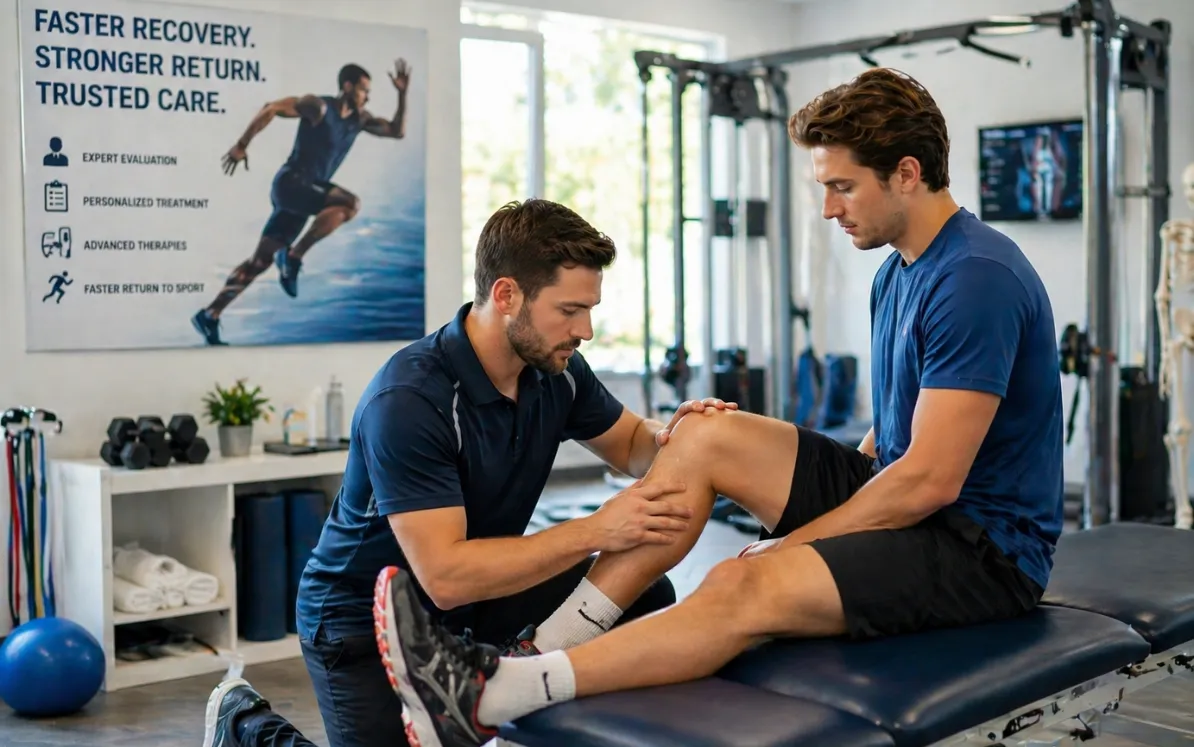
Why Athletes Need a Trusted Sports Injuries Clinic for Faster Recovery
Athletic performance sits on a foundation of physical trust. The sprinter who plants their foot and drives forward trusts that the ankle will respond without hesitation. The tennis player reaching for a wide ball trusts that the shoulder will rotate fully without pain. The cyclist pushing through a long climb trusts that the knee will track correctly through thousands of repetitions. When an injury disrupts that trust — when a movement that should be automatic becomes something to brace for, compensate around, or avoid — the impact goes far beyond the physical.
Finding the right sports injuries clinic after injury is not simply about managing pain in the short term. It is about restoring the physical foundation that athletic performance and active life depend upon, in a timeline that respects both the biology of tissue healing and the competitive or recreational goals that motivated the athletic pursuit in the first place. The quality of the clinical environment where that process happens matters enormously — and understanding why is the first step toward making the right choice.
What a Sports Injuries Clinic Actually Provides
Not all physical therapy practices offer the same level of expertise for sports-related injury management. The distinction between a general rehabilitation clinic and a dedicated sports injuries clinic lies in the depth of clinical training, the specificity of the assessment approach, and the ability to deliver the sport-specific rehabilitation that returning to athletic function requires.
A sports injuries clinic employs therapists whose training and clinical experience center on the movement demands of active, athletic populations. They assess not just the injured structure but the whole kinetic chain — because most sports injuries are not isolated events but the visible endpoint of a movement dysfunction that has been developing upstream in the body for some time. The runner whose knee hurts often has a hip stability deficit that has been loading the knee incorrectly for months. The swimmer whose shoulder impinges often has thoracic restrictions that have been forcing the shoulder to compensate for limited mid-back rotation across every stroke.
This whole-system assessment capability is what allows a sports injuries clinic to deliver sports injury rehabilitation that addresses the cause of the injury rather than simply treating the site of pain. The result is not just faster recovery from the current injury but meaningfully reduced risk of recurrence and related injuries over the long term.
The Speed Advantage of Specialized Sports Rehabilitation
Athletes consistently recover faster from injury when their rehabilitation is delivered in a sports injuries clinic environment compared to general physical therapy settings — and the reasons are specific and clinical rather than simply motivational.
Specialized sports injury rehabilitation addresses the neuromuscular control deficits that persist after injury even when structural healing has occurred. After an ankle sprain, the proprioceptive system within the ligamentous tissue that was damaged continues to provide impaired balance and position feedback long after pain has resolved — a deficit that increases re-injury risk on return to sport by a substantial margin if not specifically rehabilitated. After a knee injury, the quadriceps inhibition that develops in response to joint effusion can persist for months without targeted neuromuscular retraining. After a shoulder injury, the scapular stabilizer coordination that provides the dynamic foundation for overhead athletic movements requires specific rehabilitation to restore.
General physical therapy programs frequently address these deficits inadequately because the sport-specific loading demands of the final rehabilitation phases require clinical knowledge of athletic movement that not all therapists possess. A sports injuries clinic has this knowledge as a foundation of its clinical culture, and the rehabilitation programs it designs reflect it at every stage.
Los Gatos Sports Therapy: Serving the Active South Bay Community
Los Gatos has one of the most actively athletic community cultures in the South Bay. From competitive high school and college athletes training at local facilities, to adult recreational runners on the Los Gatos Creek Trail, cyclists on the Lexington Reservoir routes, and fitness enthusiasts across the area's gyms and studios — when injury occurs, the demand for expert sports injury rehabilitation is immediate and specific.
Los Gatos sports therapy at iMotion Physical Therapy provides the sports injuries clinic environment that this active community deserves. The Los Gatos clinic at 14901 National Avenue, Suite 102 combines specialist clinical expertise with the full range of advanced treatment modalities that serious sports rehabilitation requires: shockwave therapy for chronic tendon conditions that have stalled in recovery, laser therapy for tissue inflammation management, manual therapy, including the Mulligan Technique for joint and movement dysfunction and progressive, sport-specific exercise programs that bridge the gap between clinical function and field performance.
The return-to-sport process at iMotion Los Gatos is objective rather than assumption-based. Functional assessments — strength symmetry testing, hop and agility performance, sport-specific movement quality evaluation — provide the evidence that guides return-to-sport decisions rather than relying on time milestones or symptom resolution alone. An athlete who is pain-free but has not restored full dynamic control and movement quality remains at elevated re-injury risk, and iMotion's clinical team ensures that return to sport is based on genuine readiness.
The Role of Prehabilitation at a Sports Injuries Clinic
The most sophisticated use of a sports injuries clinic is not reactive but proactive. Athletes who have an upcoming surgery — knee reconstruction, shoulder repair, hip arthroplasty — can dramatically improve their post-surgical outcomes by investing in pre-surgical physical therapy, known as prehabilitation.
Research consistently demonstrates that athletes who complete a structured prehabilitation program before elective orthopedic surgery achieve faster rehabilitation milestones after surgery, shorter inpatient stays, and better functional outcomes at six and twelve months post-operation compared to athletes who proceed directly to surgery without preparation. The mechanism is simple: a body that arrives at surgery stronger, more mobile, and neurologically better prepared for the early demands of rehabilitation recovers from that surgery more efficiently from the first post-operative day.
At iMotion Physical Therapy, prehabilitation programs are developed around the specific surgical procedure each athlete is preparing for, their current functional baseline, and the athletic performance goals that motivated the decision to undergo surgery. This individualized approach to presurgical preparation is one of the most impactful services a sports injuries clinic can offer — and one of the most consistently underutilized.
Building a Long-Term Relationship With Your Sports Injuries Clinic
Athletes who achieve the best long-term outcomes from sports injury rehabilitation are those who treat their relationship with a sports injuries clinic as ongoing rather than episodic. Regular movement screening between competitive seasons identifies the biomechanical vulnerabilities and training load issues that precede injury before they produce one. Structured return-to-sport programs after each significant injury build the functional quality that makes the next injury less likely. And the accumulated clinical knowledge of a consistent therapist who knows the athlete's movement history provides a depth of individualized care that is impossible to replicate in one-off consultations.
iMotion Physical Therapy, with its dedicated sports injury rehabilitation expertise across locations in Fremont, San Jose, and Los Gatos, provides exactly this kind of long-term clinical partnership for the athletic communities of the Bay Area.


